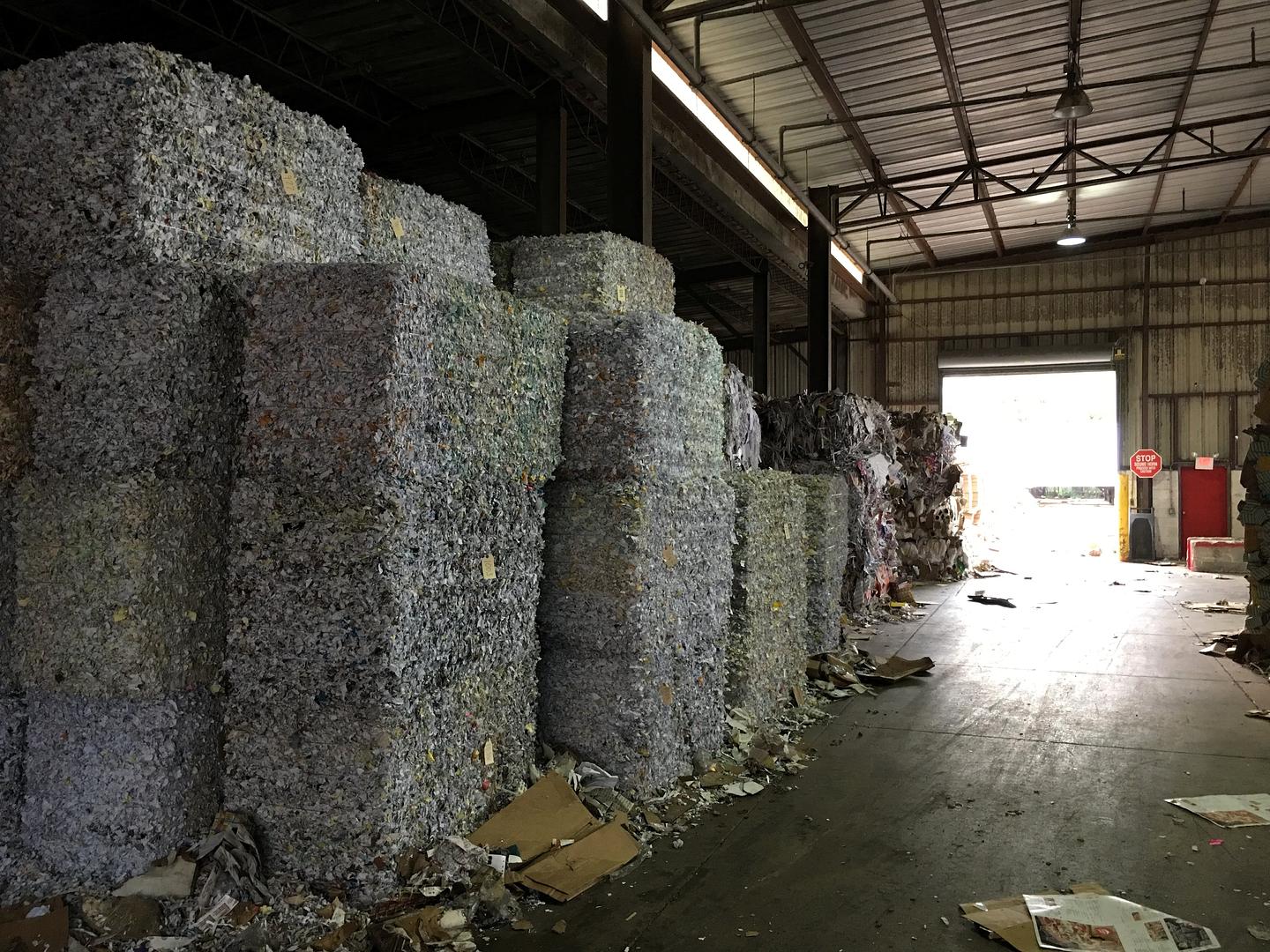
For high-volume recycling operations, the baler is not just another piece of equipment—it is the heart of the system.
When balers become bottlenecks, labor costs rise, safety risks increase, and mills begin issuing light-load chargebacks. This is why wide-mouth auto-tie balers have become the preferred solution for facilities processing large volumes of OCC, mixed paper, plastics, and secondary fibers.
This guide explains what wide-mouth auto-tie balers are, why they matter, and how to choose the right one—with real-world insight from Black River Trading’s experience in sales, service, relines, baling wire, and operator training.
What Is a Wide-Mouth Auto-Tie Baler?
A wide-mouth auto-tie baler is a horizontal baler designed with:
- A larger feed opening to accept bulky material
- High ram force for dense, consistent bales
- A fully automated tying system that eliminates manual labor
These machines are built for continuous, high-throughput operations where speed, consistency, and safety are critical.
Unlike vertical balers or narrow-mouth horizontals, wide-mouth auto-tie balers are engineered to keep material flowing without constant operator intervention.
Why Feed Opening Size Matters More Than Most Facilities Realize
One of the most common issues BRT sees in the field is material choking the infeed.
Wide-mouth balers solve this by allowing:
- Bulky OCC and flattened cartons to enter without bridging
- Mixed material streams to feed evenly
- Less pre-sorting and floor labor
A larger feed opening improves material flow, which directly improves:
- Throughput
- Operator safety
- Equipment uptime
If your operators are constantly stopping to clear jams, your baler is undersized for your application.
Auto-Tie vs Manual Tie: A Real Cost Comparison
Manual tying is often viewed as “normal,” but it is one of the largest hidden costs in recycling operations.
Auto-tie systems:
- Complete a full tie cycle in seconds
- Produce consistent tie placement and tension
- Reduce labor exposure around the bale chamber
- Improve bale integrity for stacking and transport
From a safety, labor, and consistency standpoint, auto-tie is no longer a luxury—it is the standard for high-volume facilities.
Bale Density, Consistency, and Mill-Ready Loads
Mills don’t pay for bales based on effort—they pay for weight, density, and consistency.
Wide-mouth auto-tie balers are designed to produce:
- Uniform bale dimensions
- Predictable bale weights
- Tight, stackable bales
This consistency is what allows facilities to:
- Build tighter trailer loads
- Achieve 40,000+ lb average trailer weights
- Reduce or eliminate light-load chargebacks
Many chargebacks are not caused by poor material quality—they are caused by the wrong baler for the application.
When Wide-Mouth Auto-Tie Balers Make Sense
Wide-mouth auto-tie balers are ideal when:
- Material volume exceeds what a vertical baler can handle
- Labor costs are rising
- Operators are tied up clearing jams or hand-tying
- Mills are pushing back on bale weights
- Safety incidents are increasing around the baler
If any of these sound familiar, it’s time to evaluate whether your baler is helping—or holding you back.
Common Wide-Mouth Auto-Tie Baler Classes
While every application is different, BRT frequently works with customers evaluating balers in these performance categories:
Group 21 / 10-Inch Cylinder Class
- High-volume OCC and mixed paper
- Strong balance of throughput and efficiency
- Proven platform for mill-ready fiber
72"–80" Wide-Mouth Class
- High-density fiber and plastics
- Faster cycle times
- Designed for heavier bale weights
Heavy-Duty 12" Cylinder Class
- Maximum ram force
- Highest bale densities
- Best for facilities chasing top-end trailer weights
The right choice depends on material type, feed method, labor model, and mill requirements—not just horsepower.
The BRT Difference: Equipment Is Only Part of the Solution
At Black River Trading, we don’t believe in selling machines in isolation.
Wide-mouth auto-tie balers perform best when paired with:
- Proper application analysis
- Reliable service and parts support
- Correct baling wire selection
- Preventative maintenance programs
- Customized operator training
Many facilities own capable balers but never achieve mill-ready performance because operators were never trained on:
- Bale length optimization
- Density adjustment
- Safe stacking and trailer loading
- Maximizing trailer weights
That’s where real ROI is unlocked.
Why Training and Service Matter as Much as the Baler
A wide-mouth auto-tie baler is a production asset. Like any asset, it must be:
- Maintained correctly
- Operated correctly
- Applied correctly
BRT supports customers with:
- New, reconditioned, and used balers
- Full relines and rebuilds
- Emergency and scheduled service
- Baling wire supply
- On-site operator certification
The goal is not just to make bales—it’s to protect people, improve uptime, and maximize revenue per load.
Final Takeaway: Wide-Mouth Auto-Tie Balers Are an Investment in Control
Wide-mouth auto-tie balers give operations control over:
- Throughput
- Labor exposure
- Bale quality
- Trailer weights
- Safety
When applied correctly, they pay for themselves through:
- Reduced labor
- Fewer chargebacks
- Higher rebates
- Safer operations
If you’re evaluating wide-mouth auto-tie balers—or questioning whether your current baler is truly mill-ready—Black River Trading is here to help you make that decision with clarity.